Showing posts with label u of m. Show all posts

Monday, March 19, 2007

The Human Form


First Methodist Church, Ann Arbor. The structure dates from the 1930s; this image of Christ is angular in form and is representative of the art deco style.


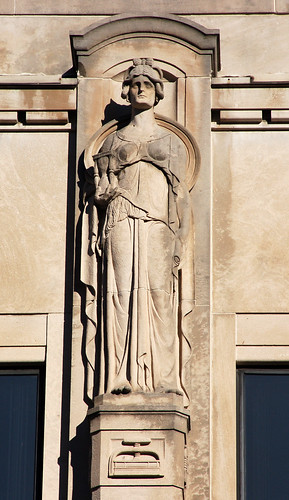
The figure of a goddess, in Kalamazoo. Represented in an Americanized classical form, she holds an hourglass and a scroll, and stands atop a book press.


Parducci relief, Lansing.


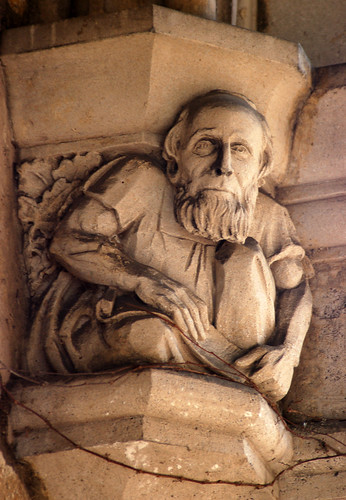
The caricature of Erastus Otis Haven, an early president of the University of Michigan. U of M Law Quad, Ann Arbor.


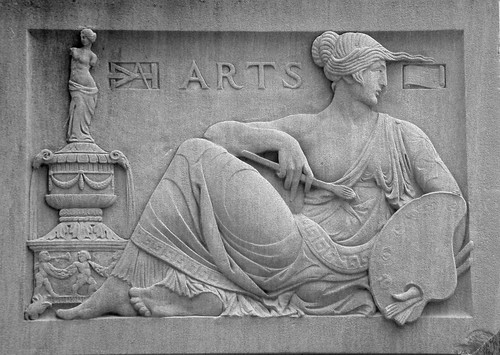
The Artisic Muse, as seen on the University of Michigan's Angell Hall in Ann Arbor. Note the Venus De Milo in the upper lefthand corner.


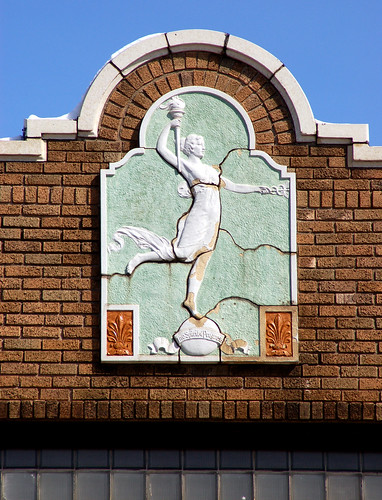
Montgomery Ward's Spirit of Progress, as seen on a former store in Three Rivers.

Wednesday, January 10, 2007

Different Fates

Didn't explore the Law Quad this time, but there have been some recent developments in the way of Ann Arbor's threatened historic buildings.

St. Nicholas

Back of Greek Orthodox Church

Ann Arbor's old St. Nicholas Greek Orthodox Church, long threatened to be torn down and developed for other uses, has been saved.

Condemned

Frieze Building

Meanwhile, the Frieze Building still sits, sadly awaiting its demise. It is scheduled to be torn down this summer to make way for new University of Michigan dormitories. The design, however, incorporates a part of the Frieze Building's façade and the result is actually quite appealing.

Tonight I have read that the historic 1920s-era Anberay Apartments, located on East University, have been bought by a developer from Chicago. The company would demolish the once-protected apartment buildings to make way for a ten-story, $20 million apartment building. If this project is passed by the city, Ann Arbor will lose one of the last things that makes it truly unique.

Friday, January 05, 2007

The Law Quad

The University of Michigan Law Quadrangle was built between 1924 and 1933. It is arguably the most beautiful set of buildings on the U of M campus.

Gargoyle VIII

Doorway

Smug

Ivy and Windows

Gargoyle II

Law Quad Entrance

Gargoyle I

Crazy frills and ivy

Beastie

Gargoyle IV

Windows

I hope to explore the inside of the Law Quad in the coming week, so check back for photographs of that adventure.

Monday, October 23, 2006

University of Michigan Exhibit Museum of Natural History

One nice thing about having an older university in town is that established colleges tend to showcase beautiful architecture. The University of Michigan in Ann Arbor is no exception, as its campus is full of many gorgeous buildings, including several museums. Besides the Kelsey Museum and the Art Museum, which will be featured on this blog in due time, U of M also has the wonderful Exhibit Museum of Natural History.

The Ruthven Museums building, which today holds not only the Exhibit Museum, but also the Museums of Zoology, Paleontology, and Anthropology, was completed in 1928. While the architect was Albert Kahn, much of the ornamentation -- including the two pumas that guard the entryway -- was executed by Carlton Angell. Built in the Classical Revival style (with a touch of Art Deco elements sneaking in), the museum is four stories tall. Less than half of the building is open to the public; the rest is devoted to research and housing the collections.

Exhibit Museum

Two large Ionic columns stand above the main entrance.

The building is beautifully decorated, both inside and out. The rotunda features a coffered ceiling covered in gilded plaster rosettes; travertine Doric columns flank the graceful staircase. The exterior of the museum is embellished with many playful creatures, some fantastical and others scientifically accurate.

Museum doorway detail

The lovely decorations above the main entraceway, sculpted by Carlton Angell.

Basilisk Flying Serpent Bird

Surrounding the doorway, many strange fauna can be seen, including the basilisk, a serpent, and a bird.

Museum Grill Detail

Grill Detail, Museum Museum Grill Detail

Delightful details can be found on the museum's wrought iron grills.

Door Detail, Museum

The front doors are decorated beautifully, all the way down to these tiny griffins, only a few inches off the ground.

Capricorn-esque Grotesque

Griffin beastie

These mythical creatures are sculpted into the platforms that hold the pumas. Currently the pumas are gone -- they are being cast into bronze and won't make their appearance until the spring of 2007.

. . .

The next time you visit the Exhibit Museum, take time to observe all the exterior ornamentation on this building -- not only around the front entrance, but on the sides of the museum, as well. You will find some surprises!

Tuesday, October 10, 2006

Classical Orders

I hope this entry isn't too similar to the one I published earlier concerning ornamentation on column capitals -- but this goes along with what we've been learning in my architecture class, and besides, it's interesting!

There were three orders of classical columns in the ancient world. The Greeks used the first two -- the Doric Order and the Ionic Order -- the most, and the Romans, who improved upon many Greek architectural elements, used the Corinthian Order quite extensively. These columns were used both in temples and public buildings, and were usually carved from marble.

The Greeks employed a certain concept called entasis when constructing their temples. Entasis is a subtle swelling of the columns, much like the trunk of a tree. Not only does it compensate for the illusion of concavity that results from straight lines, it gives the building life. Though the columns are made from cold stone, this technique turns the temples into organic, living structures. The entasis of Greek columns, especially those of the Doric Order, begins at the base and tapers upward. Roman columns swell one-third of the way up, then return to their original circumference. Entasis is a subtle feature in ancient architecture, but is very visible in temples such as the Parthenon.

The 1800s and early 1900s brought a wave of classicism to America, not just in the Greek Revival style, but in other fashions such as Beaux-Arts and the Classical Revival, as well. With these styles came classical elements -- pediments, friezes, and denturing -- and the three orders of columns. Early on, the styles were left untouched -- they were virtually exact replicas of their Greek and Roman counterparts. As time passed, architects took creative liberties with the orders, often combining them or adding even more ornamentation to the capitals (as seen in my October 5 entry).

Doric Order

Doric

This is part of an ancient Roman structure that has been moved to the University of Michigan campus in Ann Arbor. The Doric Order is characterized by a simple, unadorned capital, heavy, fluted columns, and the lack of a base.

Angell Hall

The massive columns standing in front of the University of Michigan's Angell Hall are a rather faithful representation of the Doric Order.

Fountain, Marshall, MI

The classical orders are found in fountains such as this in Marshall -- once again, a historically accurate version of the Doric Order, all the way down to the Greek-styled ornamentation.

U of M Art Museum/Alumni Hall

The Doric columns in front of the U of M Alumni Hall (now the U of M Art Museum) are made of sandstone and lack fluting along their shafts.

Ionic Order

The Ionic Order is a graceful column topped by a capital with opposing volutes. In American architecture, architects often added ornamentation to make these columns more interesting.

Petoskey Public Library number two

The Petoskey Public Library Annex, built in 1940, showcases small Ionic columns.

Ionic

A group of (wooden) Ionic columns on the Harrington Hotel in Port Huron.

Condemned

The large engaged columns on the soon-to-be demolished Frieze Building in Ann Arbor are constructed in the Ionic order.

Americanised Ionic

This small corner column on a building in Harbor Springs shows how American architects enhanced the Ionic Order with decorations.

Church, Escanaba, MI

The engaged columns on this church in Escanaba, built in 1938, are a hybrid between the volutes of the Ionic Order and the acanthus leaves of the Corinthian Order.

Corinthian Order

The Corinthian Order has a highly ornate column distinguished by the stylized acanthus leaves that decorate its capital. While the Doric and Ionic orders can be found on small buildings and houses, the Corinthian Order was usually saved for large banks, museums, and public buildings.

Corinthian

This ancient Roman column, showing the acanthus leaves of the Corinthian Order, is located on the U of M campus.

Negaunee National Bank

The Negaunee National Bank building also features Corinthian columns.